
Daylight Saving Time Ends Nov. 1: Dog Walks After Dark in Irvine and Orange County (2026)
By The Blue Sock9 min read
- 1.What Daylight Saving Time Does to Your Dog's Schedule
- 2.OC Regional Park Hours Get Shorter Too
- 3.Coyotes and the Dusk Walk in Irvine
- 4.Seen in the Dark: A Short Evening-Walk Checklist
- 5.Traveling for Thanksgiving? Write the Routine in Hours
- 6.Frequently Asked Questions
- 7.Find a Sitter Who Fits Your Dog's Evenings
Written for the November 1, 2026 time change. The sunset times are for 2026; the routine, park-hours and coyote advice applies every fall.
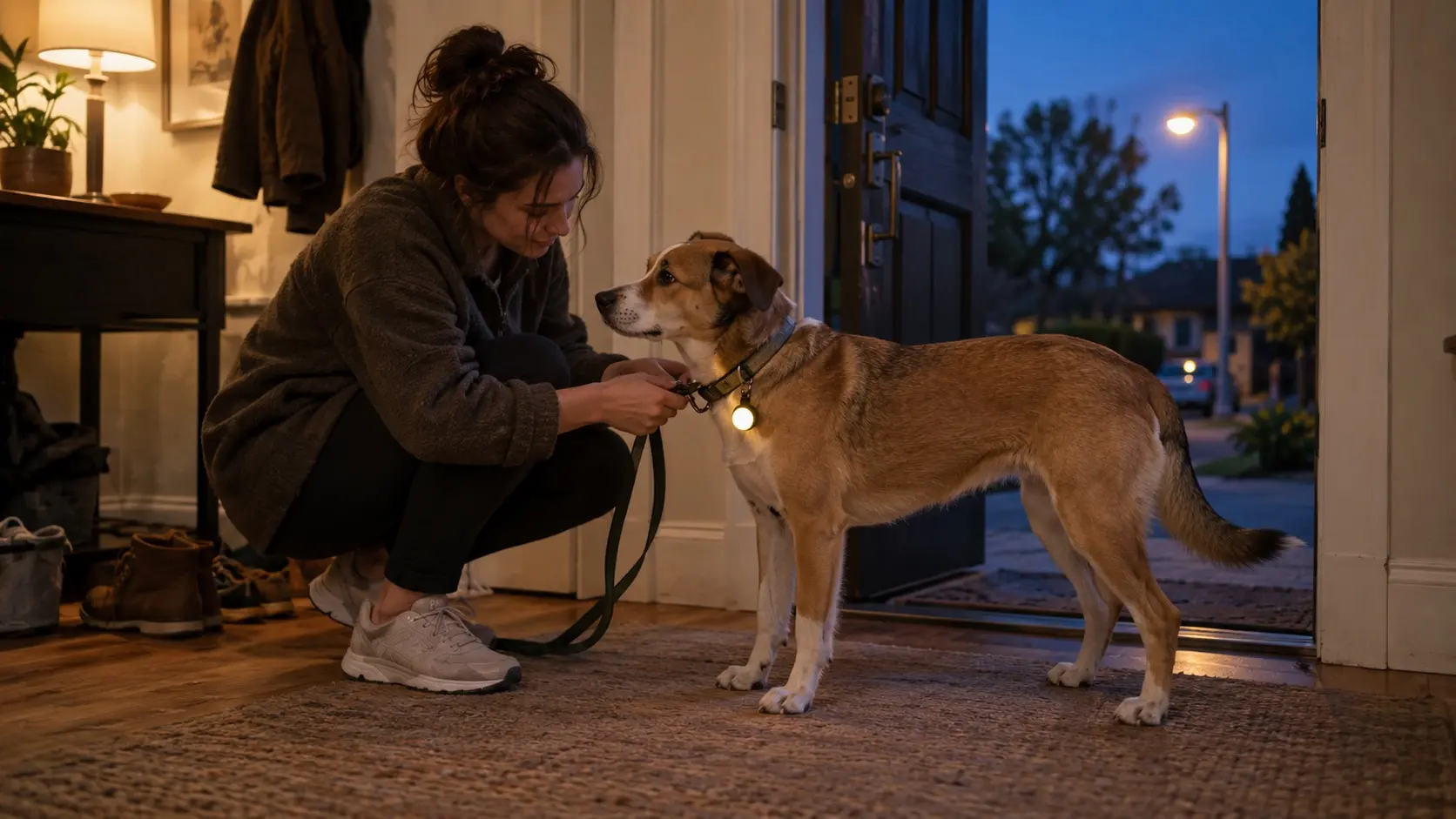
Daylight saving time ends at 2 a.m. on Sunday, November 1, 2026, and for Irvine dog parents the after-work walk moves into the dark overnight. According to the U.S. Naval Observatory's sun tables for Irvine, sunset on Saturday, October 31 is at 6:00 p.m.; on Sunday it is at 4:59 p.m. By December 1 it is 4:43 p.m., and civil twilight is over by 5:10. If you walk your dog at 5:30 on a weeknight, every one of those walks starts after sunset until about February 10, 2027, when Irvine's sunset moves back past 5:30.
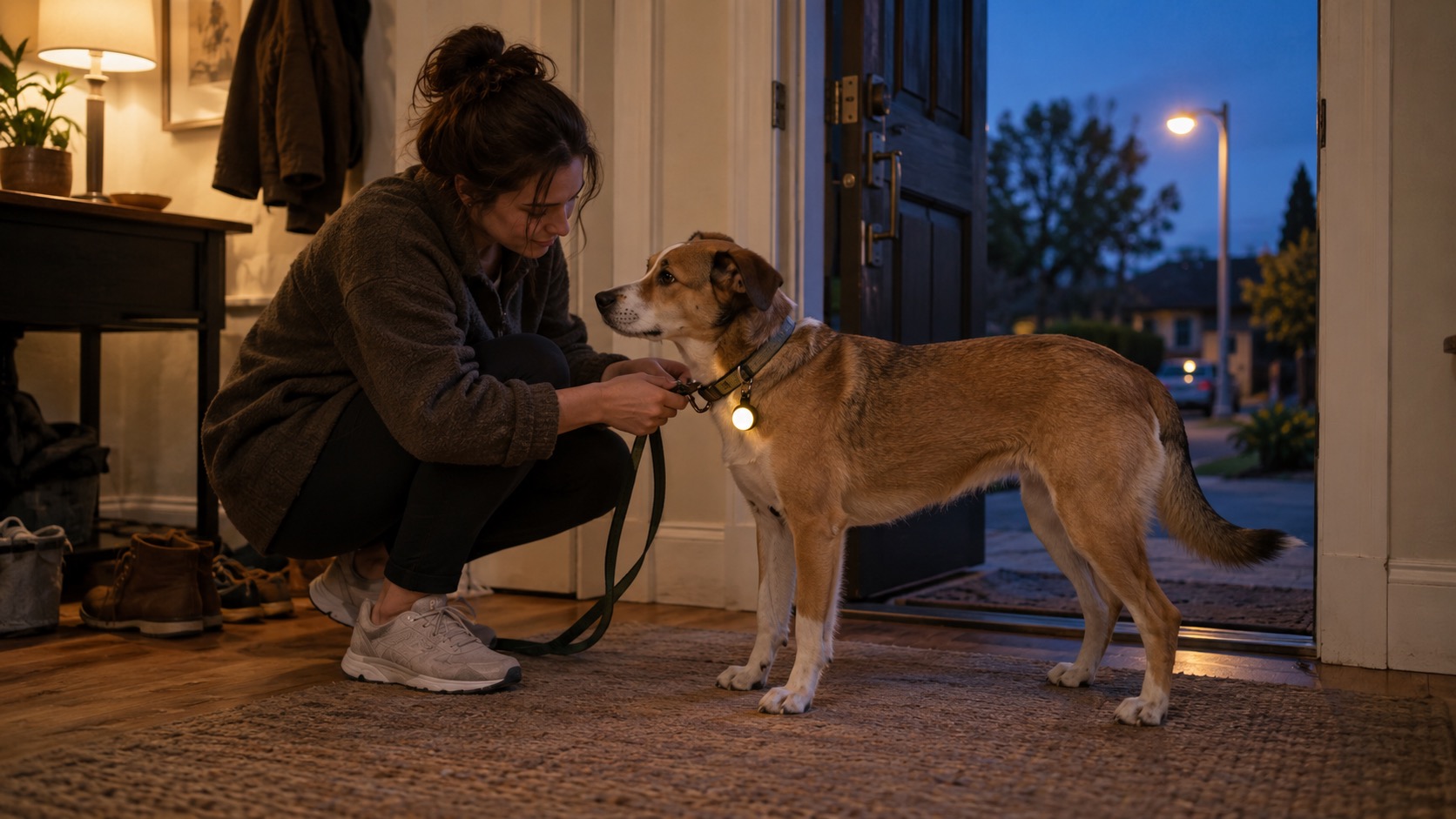
Here's what the change does to a dog's day, what closes earlier in Orange County, and how to make the dark-evening walk safer.
What Daylight Saving Time Does to Your Dog's Schedule
Your dog doesn't read a clock. As Dr. Jerry Klein, the American Kennel Club's chief veterinarian, puts it in the AKC's daylight saving guide, "Dogs respond to daylight, and they wake when the sun rises and sleep when it's dark." On November 1 your dog's body is still on the old schedule, so breakfast feels an hour late and the evening walk feels overdue by the time you get home.
The AKC's advice is not to make the jump in one night: "During the week leading up to the time change, gradually adjust your dog's schedule for eating, walking, and bedtime." A simple way to do that:
- Start Monday, October 26. Move meals and walks about 10 minutes later each day. By Saturday you've covered the full hour, and on Sunday the clock catches up to your dog.
- Move bedtime and the last potty break too, not just meals, or you'll get a 5 a.m. wake-up.
- Timed medication is a vet question, not a DIY one. Insulin, seizure medication and anything dosed every 12 hours shouldn't be shifted by guesswork. Call your veterinarian before the change and ask whether to move the dose, and how fast. Our guide to boarding a dog on medication covers how to write that schedule down for someone else.
OC Regional Park Hours Get Shorter Too
The time change also moves the closing time at the regional parks Irvine dogs use most. Last fall, OC Parks' fall-winter schedule started on November 2, 2025, the day clocks fell back, with these hours:
- 7 a.m. to 6 p.m.: William R. Mason, Carbon Canyon, Yorba, Mile Square, Craig, Clark, Laguna Niguel and Tri-City Regional Parks. Irvine Regional Park keeps the 6 p.m. close but opens at 6 a.m.
- 7 a.m. to sunset, year-round: Peters Canyon, Santiago Oaks, Talbert, O'Neill and Wieder Regional Parks, plus the wilderness parks and Upper Newport Bay.
As of October 23, 2026, OC Parks hasn't posted the 2026 announcement. Last year's switch matched the clock change, so plan on the same hours from November 1 and check the park's page before you drive. The practical effect: a Peters Canyon loop that worked at 5:30 in October now has to be finished by about 5 p.m.
The leash rule doesn't change with the season. Regional parks allow leashed dogs only, with a 6-foot maximum, and the wilderness parks don't allow dogs at all. Our Irvine hiking guide lists which trails allow dogs and which don't.
Coyotes and the Dusk Walk in Irvine
The new walk time lands right in coyote hours. The University of California's coyote Pest Note describes them as "most active after dusk and before daylight," and notes that "by late fall, juveniles may disperse to live independently." Late fall is when some young coyotes are out looking for territory of their own. Before November 1, a 5:30 p.m. walk was in daylight. After it, the same walk starts after twilight has ended.
What the guidance actually says to do:
- Keep the leash on and short. Irvine's code requires a leash of six feet or less in public places outside approved dog parks. The California Department of Fish and Wildlife's coyote page says to "leash pets while walking" and to carry "a whistle or other noisemaker to deter coyotes."
- Don't leave dogs in the yard after dark. The UC Pest Note advises that "large dogs should be brought inside after dark," and that small dogs stay indoors or in enclosed kennels. The last potty break of the night should be supervised, not a quick open-the-door.
- Report what you see. The Irvine Police Department takes coyote reports at 949-724-7092 or coyotesighting@cityofirvine.org.
Our coyote season guide covers hazing and neighborhood hot spots in more detail. That guide is about summer pup season; fall brings dispersal and darkness instead.
Seen in the Dark: A Short Evening-Walk Checklist
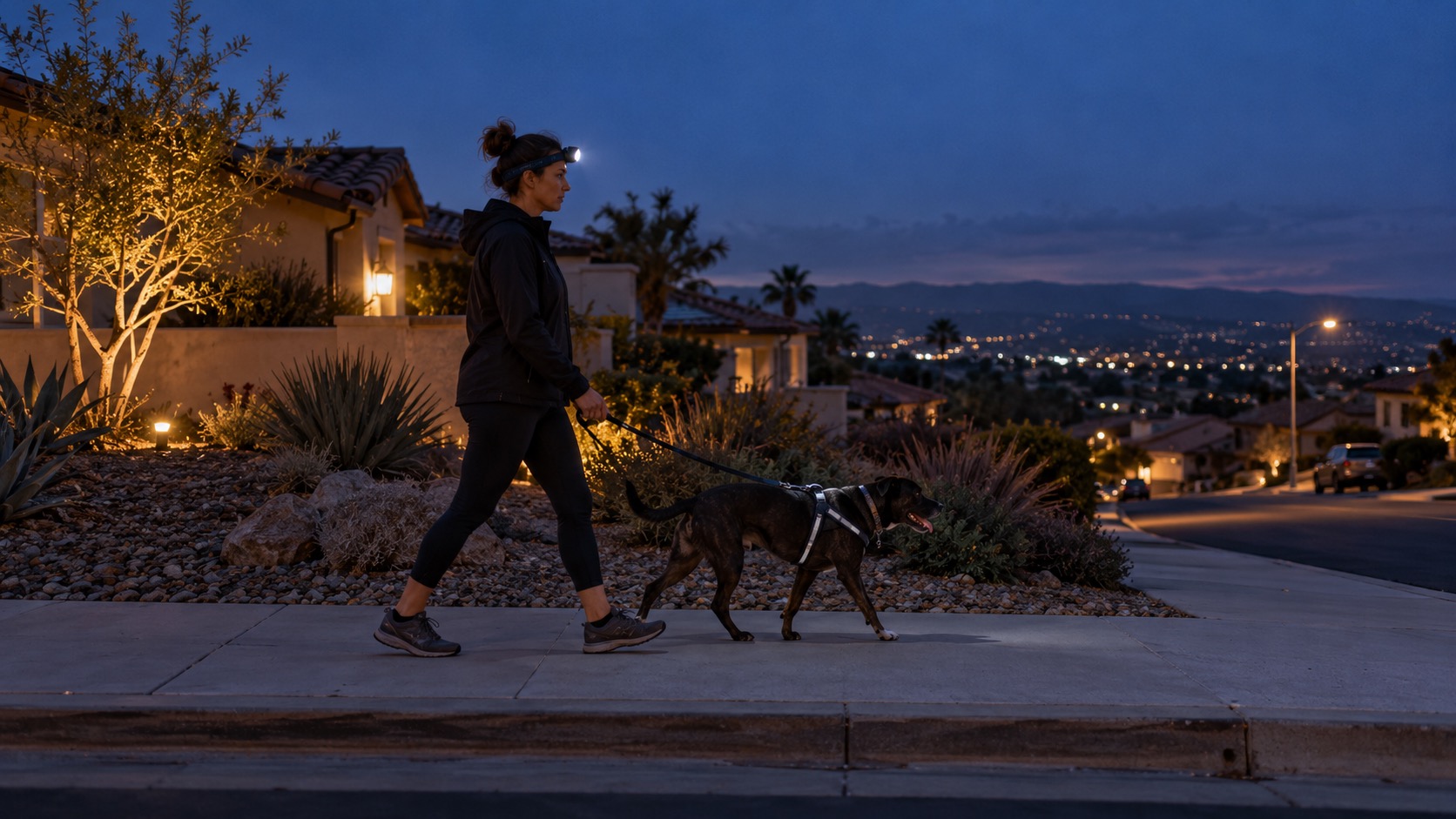
Most of what changes after dark is that drivers can't see your dog, and you can't see much on the ground. A few habits cover most of it:
- Make the dog visible from the side, not just the front. A clip-on collar light or a reflective harness shows up to a driver turning across a crosswalk. A black dog on a dark sidewalk is nearly invisible.
- Wear a headlamp so both hands are free for the leash and the bag, and so you can see what your dog is about to eat.
- Switch to lit streets. Greenbelt paths that are pleasant at 4 p.m. are often unlit at 6. Pick a sidewalk loop with streetlights for the weeknight walk and save the trail for weekend mornings.
- Know which dog parks fit the new schedule. Irvine's Central Bark has lighting fixtures and is closed the second Wednesday of every month for maintenance (check the city's field-conditions line, 949-724-MUDD, for weather closures). Costa Mesa's Bark Park is open 7:30 a.m. to 8:45 p.m. and closed all day Wednesdays.
Traveling for Thanksgiving? Write the Routine in Hours
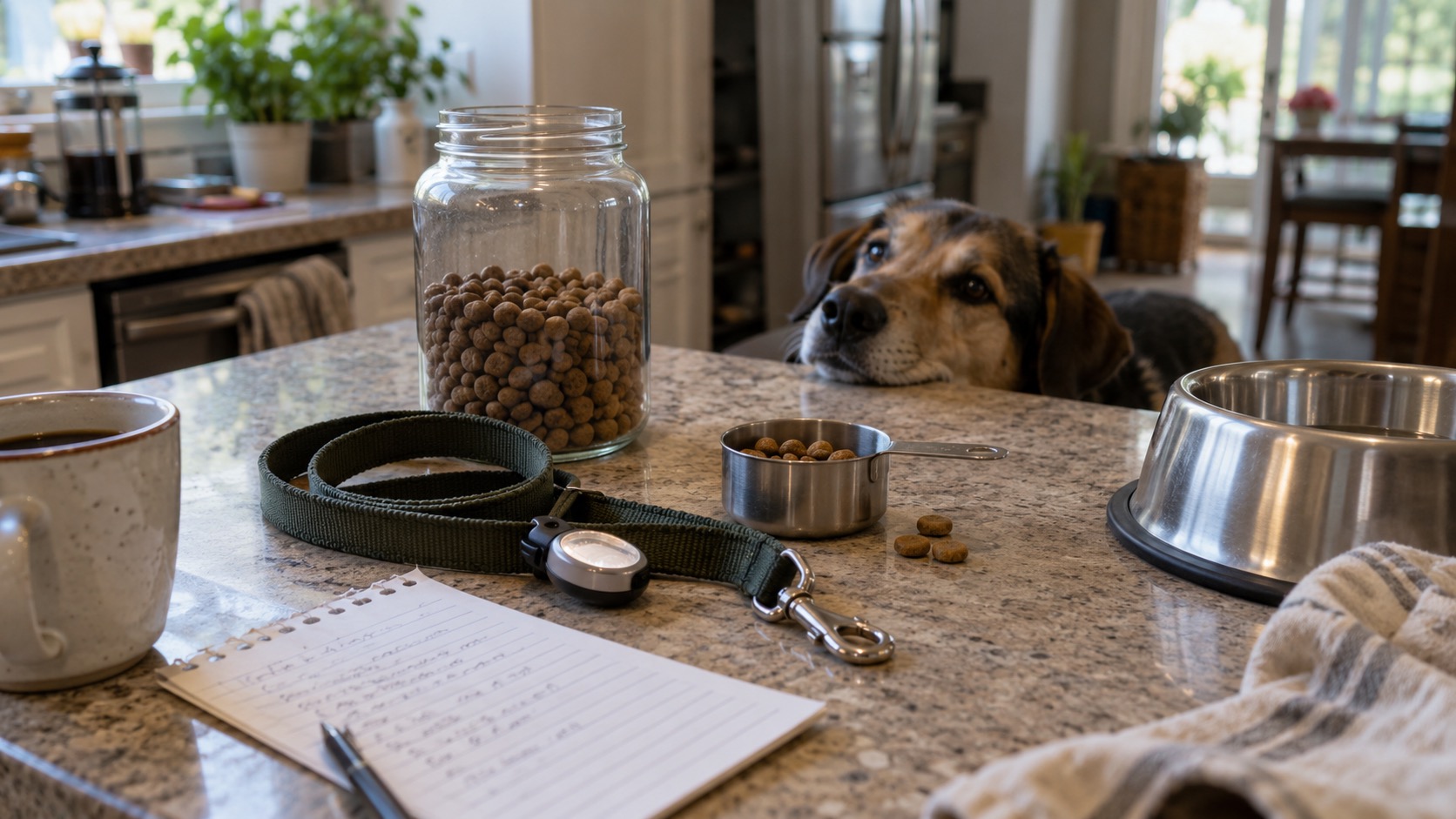
Thanksgiving falls on November 26, 2026, almost four weeks after the change, so a dog boarding over the holiday is staying on the new schedule. The handoff note matters more for a stay right after the change, because a sitter only knows your dog's evening routine if you write it down. Include:
- Meals and medication as intervals ("every 12 hours, with breakfast and dinner"), not just clock times.
- How your dog handles the dark. Does your dog balk at walking at night, bark at shadows, or need the porch light on for the last potty break? Say so.
- Where the last potty break happens: a quick leashed walk, or a fenced yard.
That last point is worth comparing before you book. On The Blue Sock, sitter profiles list home features such as a fully fenced backyard or dog-friendly walking paths nearby, so you can see how evening breaks are likely to work before a dog ever arrives. Ask at the meet & greet what a weeknight walk looks like after 5 p.m. Some sitters walk lit neighborhood loops, some rely on a fenced yard, and the right fit depends on your dog. Our Thanksgiving boarding guide covers the booking calendar and cancellation windows, and the pre-boarding checklist covers the rest of the handoff.
Frequently Asked Questions
When does daylight saving time end in 2026?
At 2 a.m. on Sunday, November 1, 2026, when clocks move back to 1 a.m. In Irvine, sunset moves from 6:00 p.m. on October 31 to 4:59 p.m. on November 1, per the U.S. Naval Observatory.
Do Orange County regional parks close earlier after the time change?
Yes. OC Parks' fall-winter schedule, which started the day the clocks changed last year, closes most regional parks, including Mason, at 6 p.m. Peters Canyon, Santiago Oaks, Talbert and the wilderness parks close at sunset year-round, which means before 5 p.m. for most of November and December. Check the park's own page for the 2026 dates.
Should I change my dog's medication time when the clocks change?
Ask your veterinarian before you move it. For medications dosed on a strict interval, like insulin, your vet may want the shift done in small steps over several days, or may say one longer interval is fine. Don't guess, and don't skip a dose to "reset" the schedule.
Are coyotes more active in Orange County in the fall?
Coyotes are most active after dusk and before daylight all year, according to the UC Pest Note. Fall adds juvenile dispersal: young coyotes leaving their family groups, which can happen "by late fall." The bigger change for dog parents is the clock. After November 1, the usual evening walk happens in the hours coyotes are most active.
Find a Sitter Who Fits Your Dog's Evenings
An hour of lost daylight changes more of your dog's day than you'd expect: meals, walks, the last trip outside. If you're traveling this season, look for a sitter whose home and routine match the evenings your dog is used to. Browse sitters on The Blue Sock, compare home features and care styles, and bring the after-dark questions to your meet & greet.
Looking for dog boarding in Irvine?
See which Blue Sock sitters host in and around Irvine. Profiles show their homes, experience and nightly rates.
You Might Also Like
 9 min
Nov 6, 2026
Rainy Season Dog Safety in Orange County (2026–27): Beach Advisories, Trail Closures and Flood Channels
Rainy season dog safety in Orange County: why to keep your dog out of the ocean for at least 72 hours after a storm, why OC Parks trails close for up to three days, and the flood-channel rule that matters most.
Read More → 9 min
Nov 13, 2026
Newport Beach Christmas Boat Parade 2026 With Your Dog: Fireworks Night, Leash Rules and Where to Watch
Taking your dog to the Newport Beach Christmas Boat Parade, Dec. 16–20, 2026? Which night has fireworks, the after-4:30 p.m. leash rule, and a checklist.
Read More → 10 min
Oct 30, 2026
Christmas Dog Boarding in Orange County (2026): Irvine and Costa Mesa Schools Are Out Dec. 21–Jan. 1, So Book Before Thanksgiving
Christmas dog boarding in Orange County is a two-week booking in 2026: Irvine, Costa Mesa, Capistrano and Santa Ana schools are out Dec. 21–Jan. 1. When to book, how the Dec. 24–Jan. 3 holiday rate and its seven-night cap work, and what a 14-night stay costs.
Read More →